Araside Display Font for Handmade Creators
If you’ve ever spent 20 minutes scrolling through font libraries trying to find that one perfect typeface—the kind that makes your candle label feel boutique, your birthday invite feel joyful, and your SVG wall art feel instantly shareable—you’ll understand why Araside landed in my cart and hasn’t left since. It’s not just another display font. It’s a warm, bold, slightly playful, and consistently readable typeface built for makers who sell real things—not just pixels.
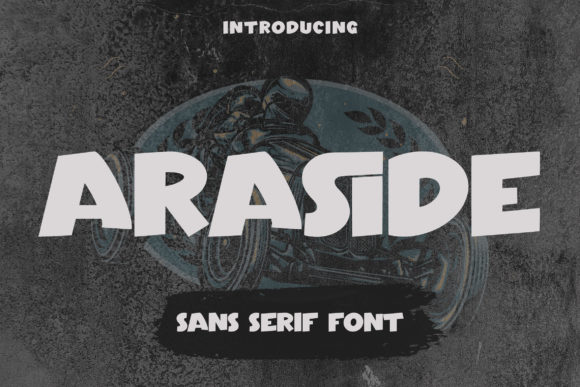
Araside has this lovely cartoon-adjacent charm without tipping into “kiddie” territory. The letters are rounded but intentional, chunky but not heavy, friendly but still polished. Think of it as the font equivalent of hand-painted signage at a local bakery—inviting, memorable, and quietly confident. That balance is rare in display fonts, especially ones designed for commercial craft use.
I use Araside across nearly every physical product I make: from kraft paper gift tags for handmade soap to vinyl-cut farmhouse-style signs for baby nurseries. Its strong x-height and open counters mean it cuts cleanly on Cricut and Silhouette machines—even at ¾ inch tall. I’ve tested it on matte sticker paper, glossy labels, and heat-transfer vinyl with zero issues. No ghosting, no broken joins, no awkward spacing surprises when scaled down. That reliability matters when you’re batch-producing 50 wedding welcome boards or prepping seasonal printable bundles for Etsy.
For product packaging, Araside shines on short, high-impact text: “Small Batch,” “Hand-Poured,” “Made With Love,” or even just a name—like “Maple & Honey Co.” It’s not meant for paragraphs, and that’s exactly why it works so well. As a display font, it’s built for titles, headers, focal words, and decorative phrases. Use it for the main headline on your planner cover, the “Happy Birthday!” on a 5×7 card, or the shop name on a reusable tote bag. It commands attention without shouting.
Seasonal projects benefit especially. Last December, I used Araside for holiday mug designs (“Cozy Season,” “Hot Cocoa Crew”) and found customers consistently commented on how “festive but not cheesy” the typography felt. In spring, it gave floral-themed stickers a cheerful lift—“Bloom Boldly,” “Grow Wild”—without competing with delicate line art. Even in minimalist contexts, like black-and-white wedding stationery, Araside adds warmth and personality where serif fonts can feel too formal and sans serifs too neutral.
Readability at small sizes is where many display fonts falter—but Araside holds up. At 14 pt on a 2×3” product tag, it’s still legible and charming. I avoid going smaller than 12 pt for printed labels, but for digital mockups or social media graphics, it renders beautifully at 10 pt when paired with generous letter-spacing. Pro tip: always preview your cut file at actual size before sending to your machine—and test print on scrap material first. Araside’s consistent stroke weight helps avoid thin-line breakage during cutting.
Font pairing is intuitive. I often combine Araside with a clean, neutral sans serif (like Montserrat or Inter) for body text on invitations or product descriptions—giving hierarchy without visual noise. For a more organic feel, I’ll pair it with a subtle handwritten font for names or dates (think soft loops, no dramatic swashes). Avoid stacking it with other bold display fonts—that’s where clutter creeps in. Let Araside be the star, then support it with quiet, functional companions.
Inside the Araside package, you’ll find OTF and TTF files—both work flawlessly in Design Space, Silhouette Studio, Canva, and Adobe apps. There are no extra stylistic sets, ligatures, or swashes listed, which I actually appreciate: it keeps things simple, predictable, and production-ready. No hunting for alternate glyphs mid-batch. What you see is what you get—and that consistency saves time when you’re juggling orders, inventory, and design revisions.
Commercial licensing is clear and practical. You’re fully covered to use Araside in physical products you sell (stickers, mugs, shirts, greeting cards), digital downloads (printables, templates, SVG bundles), and client work—including logos and branding assets. Just remember: you can’t resell or redistribute the font files themselves. That’s standard, fair, and frankly refreshing—no confusing tiers or “extended license” upsells when you’re launching your first Etsy shop.
What truly sets Araside apart isn’t just how it looks—it’s how it performs across mediums. It translates well from screen to print to vinyl to embroidery digitizing (when simplified appropriately). It reads well in natural light on a wooden sign and pops on Instagram stories. Customers notice it—not because it’s flashy, but because it feels *intentional*. That perception of care elevates your whole brand identity, whether you’re selling $8 printable wall art or $45 custom wedding signage.
I’ve used it for boutique clothing tags (“Wear Joy”), children’s game packaging (“Rainbow Quest”), apothecary labels (“Lavender Calm”), and even chalkboard-style café menus. Each time, it adds a touch of approachable confidence—never childish, never cold, always on-brand. And because it’s a display font with strong personality, it helps your products stand out in crowded marketplaces without relying on trends that fade by next season.
If your current go-to font feels tired, overused, or inconsistent across formats, Araside is worth the swap. Not as a novelty, but as a reliable, expressive, and commercially smart tool—one that supports your craft instead of complicating it.